A browser with crews
Technical · July 2025
WeaveHacks
In July 2025 the three of us flew out to San Francisco for WeaveHacks, the agent protocols hackathon Weights & Biases ran with Google. Most AI browser demos that summer were about doing the browsing for you. We built the opposite bet, a browser that watches what you're trying to do and helps you do it yourself.
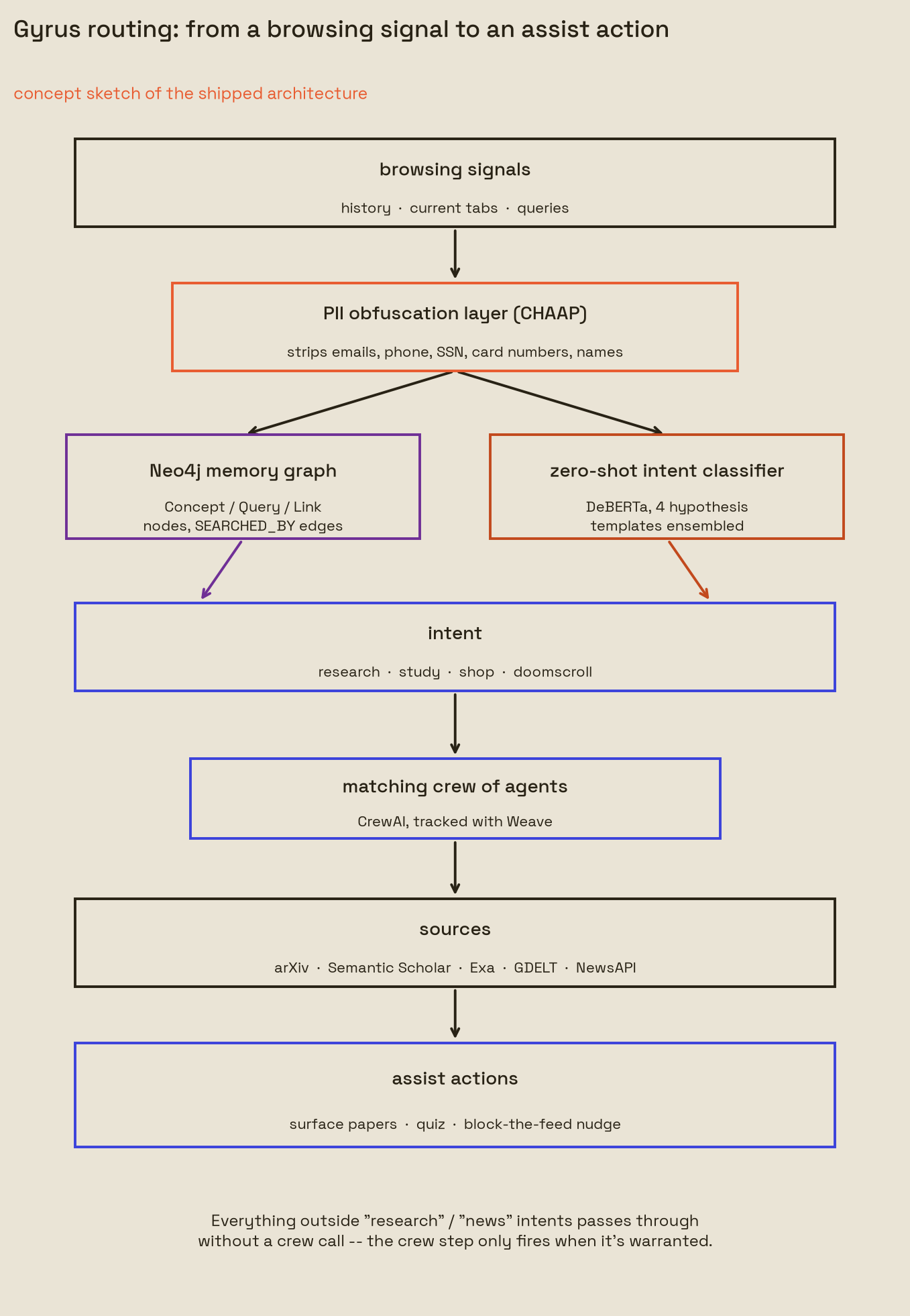
Gyrus assigns you crews, small teams of agents tuned to what you're actually up to. If you're researching, the crew pulls papers and primary sources into reach. If you're studying, it quizzes instead of summarizing. The browser's job is to notice which mode you're in, and it learns that from your own history rather than asking.
Gyrus started life as Clay. We renamed it for the hackathon in case Weights & Biases minded the name, and the research behind it later turned into Friction, a different crew taking the same question down to the operating system.
the intent layer
Detecting what someone is trying to do from their browsing is the whole product. Get that wrong and the crews are noise.
Technical
The browser is Electron. Behavior accumulates in a Neo4j memory graph, and a zero-shot classifier fine-tuned on the ORCAS query-intent dataset, about two million entries, reads intent from history and current activity. Crews run on CrewAI with Langchain for memory and reasoning, pulling from GDELT, NewsAPI, Exa, Semantic Scholar and arXiv depending on the crew. Weave traced every agent decision, which during a 36-hour debug loop mattered more than any of us expected. Raihan built the PII obfuscation layer so the memory graph learns your patterns without storing your identity.
Personal
I keep coming back to tools that make people more capable instead of more passive, and a browser is where that fight actually happens, because it's where attention goes to die. I don't know if an agentic browser can win against the feed. Building one that at least tries felt better than another summarizer.