Physical friction for the flow state
Technical · March 2026
Fig Build
After Gyrus I kept pulling on the same thread. Gyrus, which started life as Clay before we renamed it, asked how a browser could protect thinking instead of replacing it. Friction asks the same question below the browser, at the operating system and the desk itself. Different crew this time, Haley Potter and Miami Celentana, at Figma's Fig Build in March 2026.
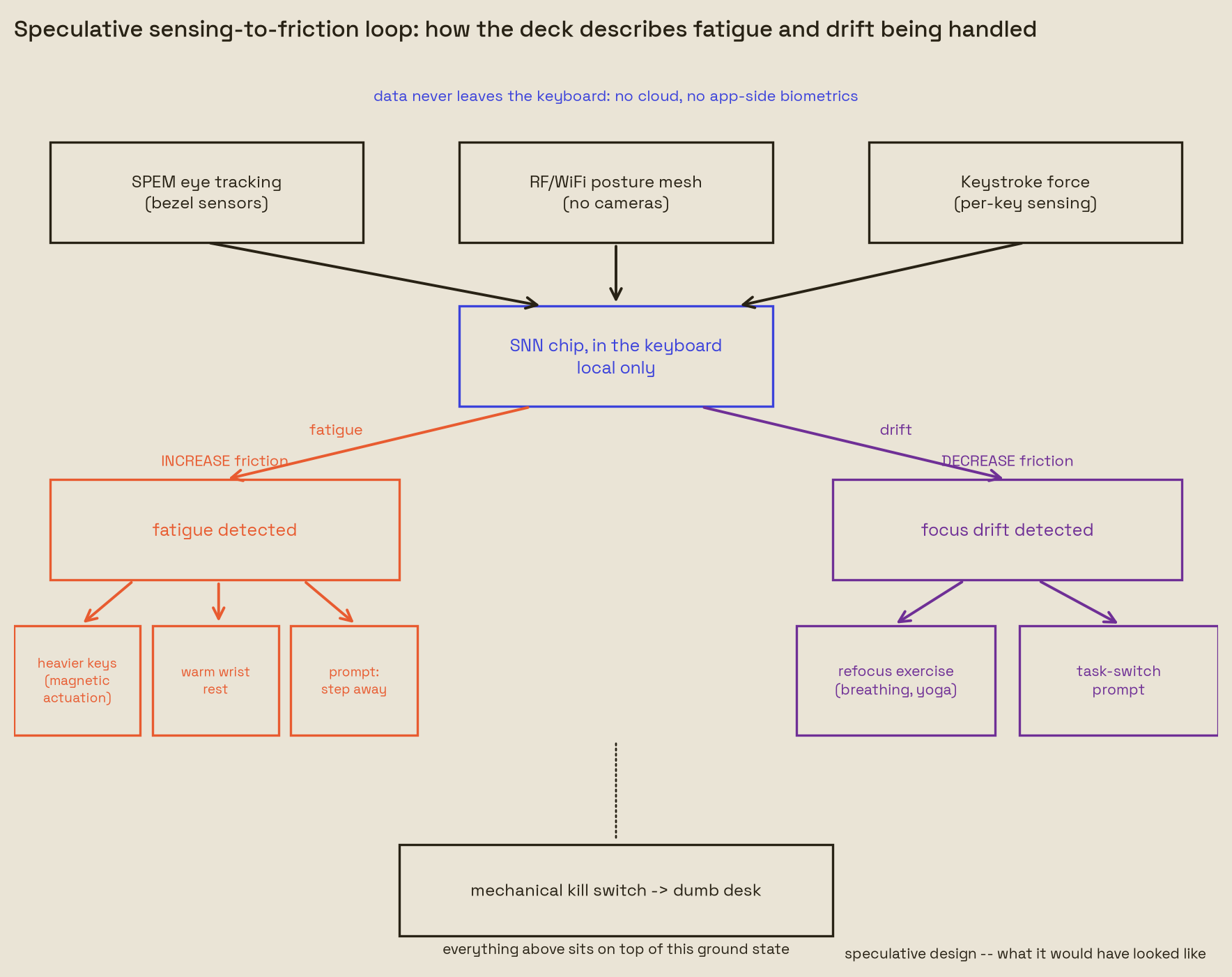
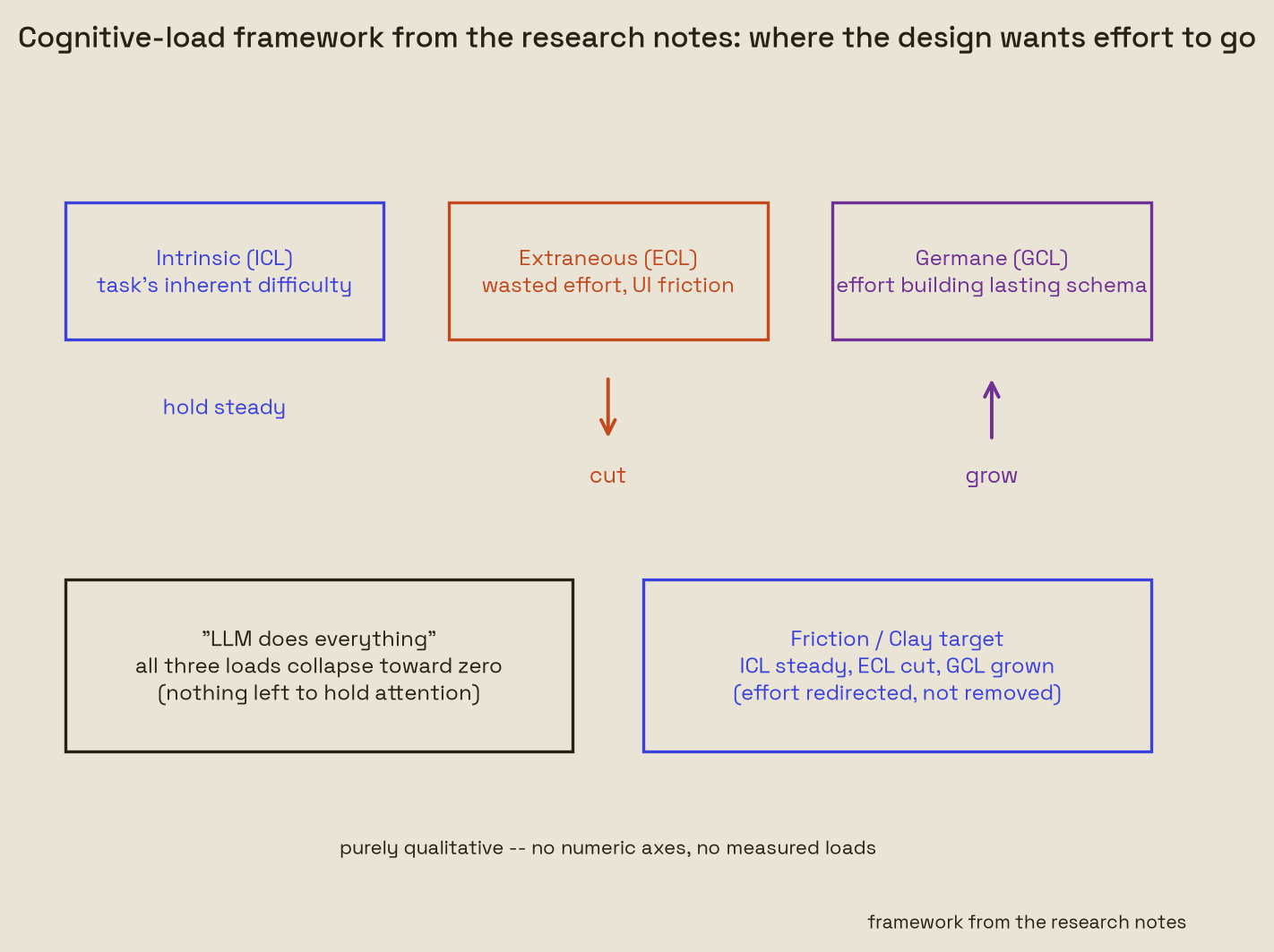
Friction is speculative interaction design, a focus system that never shows you a timer. You tell it how long you have and what you're working on, design a song as a warm-up exercise, and it disappears. When your body says you're fraying, the machine pushes back physically. Keys get heavier to type. The wrist rest warms. The message arrives through your hands, not through a notification, and it says stop before burnout, not focus harder.
It's a design fiction with a working simulated OS, not a product. Most focus apps guilt you with metrics. We wanted the opposite register, an environment that treats broken focus as information.
the calibration stack
The interesting design problem was how a desk learns what your focus looks like without cameras and without shipping your biometrics anywhere.
Technical
The concept hardware runs three calibrations. Aperture focus tracks smooth-pursuit eye movements from bezel sensors to baseline cognitive load. An RF volumetric mesh reads posture from WiFi signal reflections, no camera, learning the difference between engaged and slumped. Kinetic and acoustic calibration tunes magnetic key resistance to your typing force and syncs 40Hz haptics to your audio. A spiking neural network chip in the keyboard processes all of it locally, and the trigger logic is a set-theory canvas, drag high SPEM stutters into intersection with slumped posture and wire that to heavier keys. Trend data stays on the keyboard, weekly recaps render focus as depth of field instead of scores, and a mechanical kill switch returns the whole desk to dumb mode.
What exists in the repo is the Figma Make export, a simulated desktop OS in React with the friction keyboard panel, flow pill, progressive vignette and the fake apps to demo interventions against. The hardware is a concept, and the writeup treats it that way.
Personal
We finished about five minutes past the submission deadline, so Friction was never judged. It stung more than losing would have. I'd still rather have the project than the placement, the research notes from Clay finally became a physical design language, and I got to build with people I hadn't built with before. But set two alarms.