A second memory
Technical · February 2024
RevolutionUC 2024
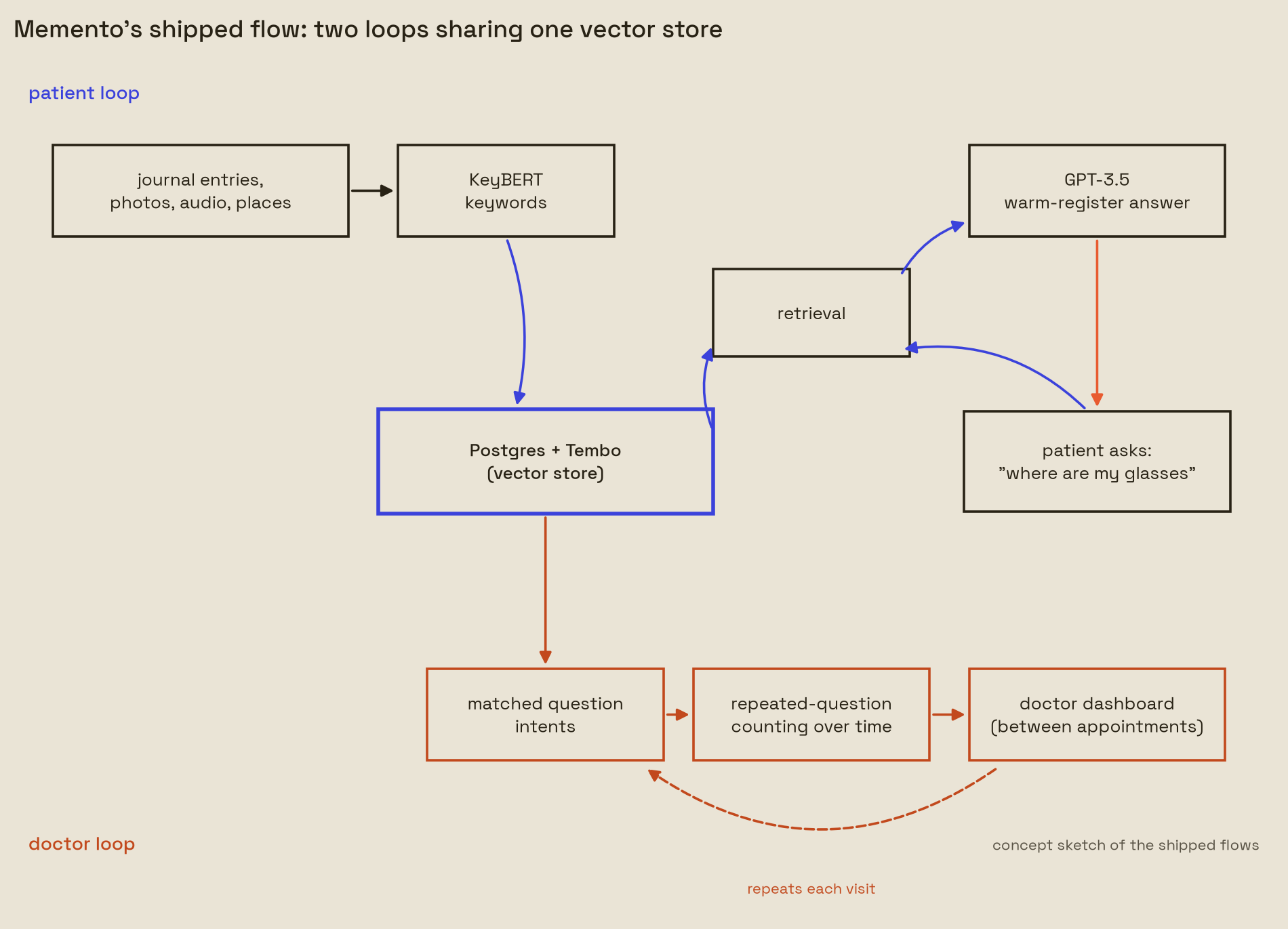
Memento is a journal for people with Alzheimer's that answers questions. The patient, or a caregiver, records the day as entries, photos, audio, places. Later the patient can just ask it things. Where did I put my glasses. What did I do on Tuesday. Who visited last week. The journal answers from what was recorded, in a warm register rather than a database register.
There's a second user, the doctor. If the same question gets asked more and more often, that curve means something clinically. Memento keeps that signal and puts it on a dashboard, so the physician sees how memory is actually behaving between appointments instead of relying on a fifteen-minute visit.
We built it at RevolutionUC 2024, me, Kaaustaaub, Raihan and Grant. It took 3rd overall, Best Social Impact Hack, Medpace's clinical trial award and Tembo's Postgres award.
Memento
The retrieval had to work for someone who can't remember the keyword they're supposed to search for. That constraint shaped most of the design.
Technical
Entries land in PostgreSQL on Tembo with vectorized keywords, KeyBERT pulls the key terms at write time, and GPT-3.5 wraps retrieved entries into a response tuned to be plainly worded and calm. The repeated-question tracking is just counting matched intents over time, which is the kind of boring mechanism that makes a useful clinical chart.
We started the weekend in React Native and SwiftUI, lost hours to styling, and pivoted to a React web app scaled for mobile. We also outgrew Cloud Run's memory limits mid-hack and moved behind a proxy server. Neither pivot shows in the demo, both ate a third of the clock.
Personal
Grant's grandfather was diagnosed with Alzheimer's in 2023. His grandmother advocates for ADRD families in Cincinnati, and the conversation with her is where the design came from, especially the doctor side. We were building for two specific people, which is a different feeling than building for a judging rubric. I think it's why the emotional register of the responses got as much attention as the retrieval.